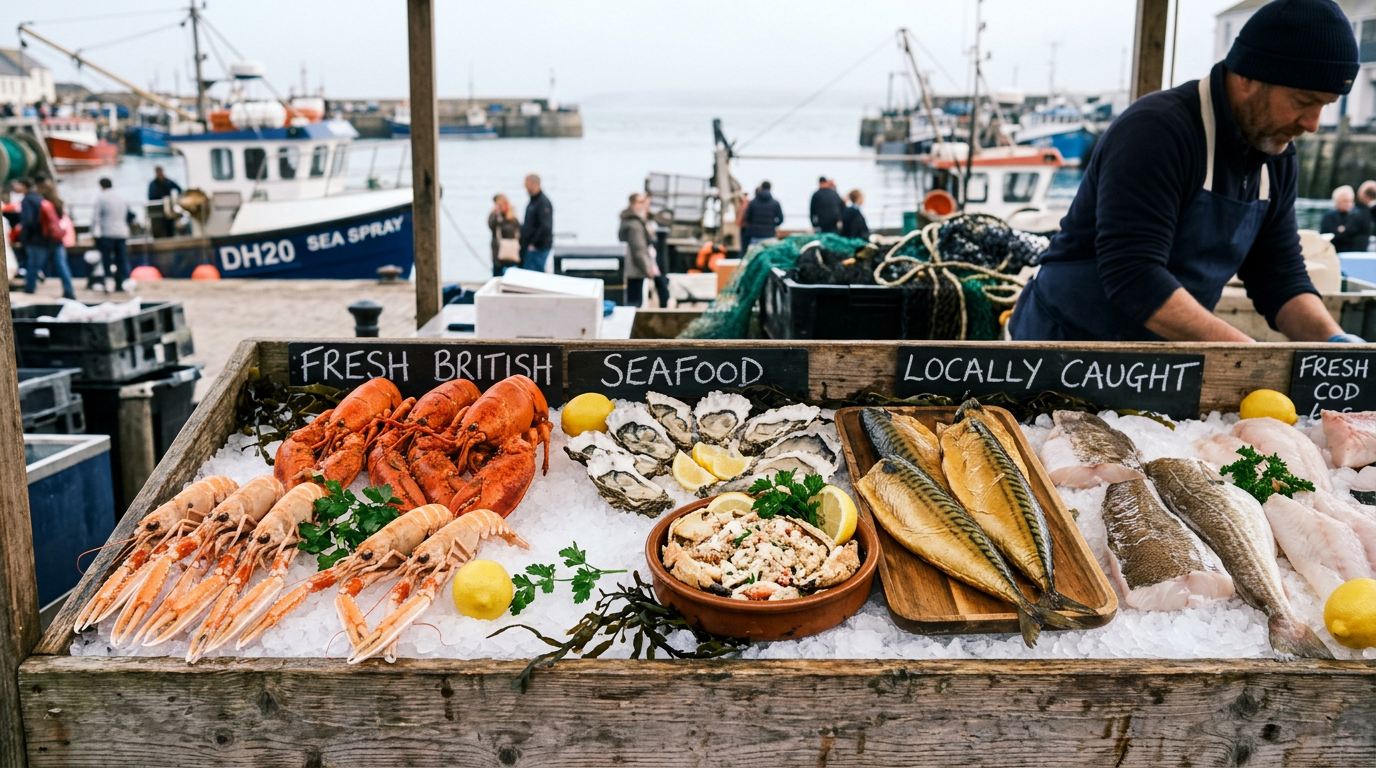
Britain is surrounded by some of the most productive fishing waters in the world. The North Sea, the Atlantic off Scotland's west coast, and the cold waters around Cornwall produce lobster, crab, scallops, oysters, mackerel, cod, haddock, and langoustines that are exported to restaurants across Europe and beyond. And yet the average British household spends just £1.47 per week on fish and seafood — far less than the European average.
The paradox of British seafood is that the UK catches some of the finest product in the world, then sends most of it abroad. Understanding what's available, where it comes from, and how to get the best of it is the starting point for anyone who wants to eat better, support British fishing communities, and pay less than restaurant prices for exceptional fish.
What the UK Actually Catches
British waters support a remarkable diversity of commercial species. The ten most landed by value tell the story of British fishing more clearly than any restaurant menu:
| Species | Main Region | Season | Best For |
|---|---|---|---|
| Atlantic Salmon | Scotland | Year-round (farmed) | Everyday cooking, smoking |
| Brown Crab | Cornwall, Cromer | April–November | Dressed crab, bisque |
| Langoustine | Scotland | April–October | Simply grilled, pasta |
| Mackerel | SW England, Scotland | May–September | Grilled, smoked, cured |
| Haddock | North Sea, Scotland | Year-round | Fish & chips, smokies |
| Lobster | Cornwall, Channel Islands | April–October | Thermidor, grilled |
| Oysters | Essex, Kent, Mersea | Sept–April (wild) | Raw, baked, Kilpatrick |
| Scallops | Orkney, Shetland, W Scotland | Year-round | Pan-seared, ceviche |
| Cod | North Sea (managed stocks) | Year-round | Battered, roasted |
| Mussels | Wales, Scotland, Devon | Sept–March | Moules marinières, steamed |
The Seafood the UK Actually Eats
Catch and consumption are two very different things. The most popular seafood in UK homes — by a wide margin — is salmon. It accounts for roughly 30% of all seafood consumed by volume, almost all of it farmed in Scottish sea lochs. Behind salmon comes cod, tuna (canned), haddock, and prawns.
The gap between what Britain catches and what it eats is most visible in shellfish. The UK exports around 80% of its crab catch, most of it going to Spain and France. Similarly, the vast majority of Scottish langoustines end up in Spanish and Italian markets. A langoustine bought at Billingsgate market in London will typically cost £8–12 per kilo; the same weight sells for three to four times that in a Barcelona restaurant.
"We send our best shellfish to Spain and import cheap farmed prawns from Southeast Asia. It's the great absurdity of British food culture." — a south-west England fish market trader, 2023
Where to Buy It: The Options Compared
The route from water to plate matters for both quality and price. There are five main channels, each with trade-offs:
Fishmongers
Independent fishmongers offer the widest selection and the best advice. A good fishmonger will tell you what came in that morning, what to do with it, and will fillet, skin, or pin-bone on request. Prices are often lower than supermarkets for equivalent quality. The Fish Society, Fish for Thought, and Coln Valley Smokery all deliver nationwide.
Coastal Markets
Whitby fish market, Brixham in Devon, Newlyn in Cornwall, and Billingsgate in London are among the best-known. Buying directly from or near landing sites means the shortest possible chain from boat to kitchen. Brixham auction runs early mornings; Billingsgate opens at 4am and closes by 8:30. Not convenient — but nothing matches the quality or the price.
Supermarkets
Convenient and consistent, but the selection is narrow and the sourcing opaque. Supermarkets typically carry salmon, cod, haddock, and prawns reliably; shellfish selections vary by store and season. Look for MSC certification and clear country of origin labelling. The own-brand ranges at Waitrose and M&S tend to source more carefully than budget options.
Online Delivery
The post-pandemic growth in direct-to-consumer fish delivery has been significant. Services like Rockfish (Devon), Wright Brothers, and The Cornish Fishmonger deliver overnight-chilled product directly from day boats or small fishing communities. Subscription boxes typically run £25–45 for two to four people and often include species you would not otherwise encounter.
Farm Shops and Food Halls
In coastal counties, farm shops and food halls often stock locally caught product — particularly shellfish — alongside the usual meat and cheese. Borough Market in London, Scarborough market, and St Ives harbour shop are perennial recommendations.
The Five Most Underrated British Seafood Species
Five species that are abundant, sustainably caught, affordable, and underused in British home cooking:
- Megrim sole — A flat fish from Scottish waters, similar to Dover sole in texture but a fraction of the price. Few British consumers have heard of it; most of the catch goes to Spain, where it is highly regarded.
- Pouting — A member of the cod family, abundant in the North Sea, rarely seen in shops. Sweet, firm white flesh that works well fried or in fish cakes.
- Coley (saithe) — Darker flesh than cod but similar flavour when cooked. MSC-certified North Sea stocks are in good health. One of the cheapest white fish available.
- Whelks — Harvested in enormous quantities off the Kent coast, almost entirely exported to South Korea. Sustainable, cheap where available, and excellent with vinegar and brown bread.
- Dab — A small flat fish, often caught as bycatch, occasionally sold in coastal fish shops for under £3/kg. Delicate flavour, best pan-fried whole in butter.
Buying in season means better flavour and lower prices. Oysters are at their best in the months with an 'R' (September to April). Brown crabs are sweetest in late summer and autumn. Mackerel is richest in fat and flavour in July and August. Scallops are available year-round but best avoided during spawning (March–May) when the roe is spent.
Sustainable Seafood: What the Labels Mean
Three certification schemes dominate British seafood labelling:
MSC (Marine Stewardship Council) — The most widely recognised wild-catch certification. Blue label with a fish tick. Indicates the fishery has been independently assessed against standards for sustainable fishing and traceability. Coverage is patchy: some well-managed fisheries have not sought certification because the process is expensive.
ASC (Aquaculture Stewardship Council) — The equivalent for farmed seafood. Covers salmon, mussels, oysters, and prawns among others. Sets standards for feed, chemical use, escapes, and social responsibility.
RSPCA Assured — Focuses on animal welfare standards in farming. Relevant for salmon and trout aquaculture. Does not assess environmental impact in the same depth as ASC.
The simplest practical rule: buy British-caught where possible, buy from fishmongers who know their suppliers, and ask questions. The more the British public buys and cooks seafood that isn't salmon and cod, the more economically viable it becomes for fishing communities to land and sell a wider range — rather than export everything interesting to continental Europe.
A Quick Guide to Cooking What You Buy
The most common mistake with seafood at home is overcooking it. Fish continues cooking after it leaves the heat. A 3cm-thick piece of cod at room temperature needs roughly 8–10 minutes in a 200°C oven — not 20. Prawns become rubbery after two minutes of heat. Scallops need thirty seconds each side in a very hot pan. The less you do to good, fresh seafood, the better it tastes.
A simple framework: white fish (cod, haddock, pollock) does well roasted, battered, or in a sauce. Oily fish (mackerel, sardines, herring) is best grilled, smoked, or cured. Shellfish (lobster, crab, langoustines) needs the least intervention — boiled or grilled with butter and lemon is nearly always the correct answer. Bivalves (oysters, mussels, clams) work with white wine and aromatics, or simply raw.
Britain has always been a seafood nation by geography if not always by habit. The product is here. The supply chains are improving. What's changed is that, for the first time in a generation, it is genuinely possible to eat the best of British waters without going to a restaurant — and without paying restaurant prices.
Editorial note: This article is intended for general informational purposes. seafoodsnw.com is an independent publisher.